
By Seyifunmi Azeez
Nigeria’s student loan scheme has disbursed over N227.5 billion to more than 1.3 million beneficiaries since its launch, marking a sharp increase in payouts within weeks, according to the latest data from the Nigerian Education Loan Fund (NELFUND).
A dashboard report generated on March 30, 2026, shows that total applications have climbed to 1,759,834, with 1,315,086 students already receiving financial support under the programme. The figures indicate continued growth in both uptake and disbursement, reflecting sustained demand for education financing.
The latest total disbursement of N227.5 billion represents a significant jump from earlier figures released in March. As of March 9, 2026, NELFUND reported N206.29 billion disbursed to 1,164,222 students across about 270 institutions nationwide.
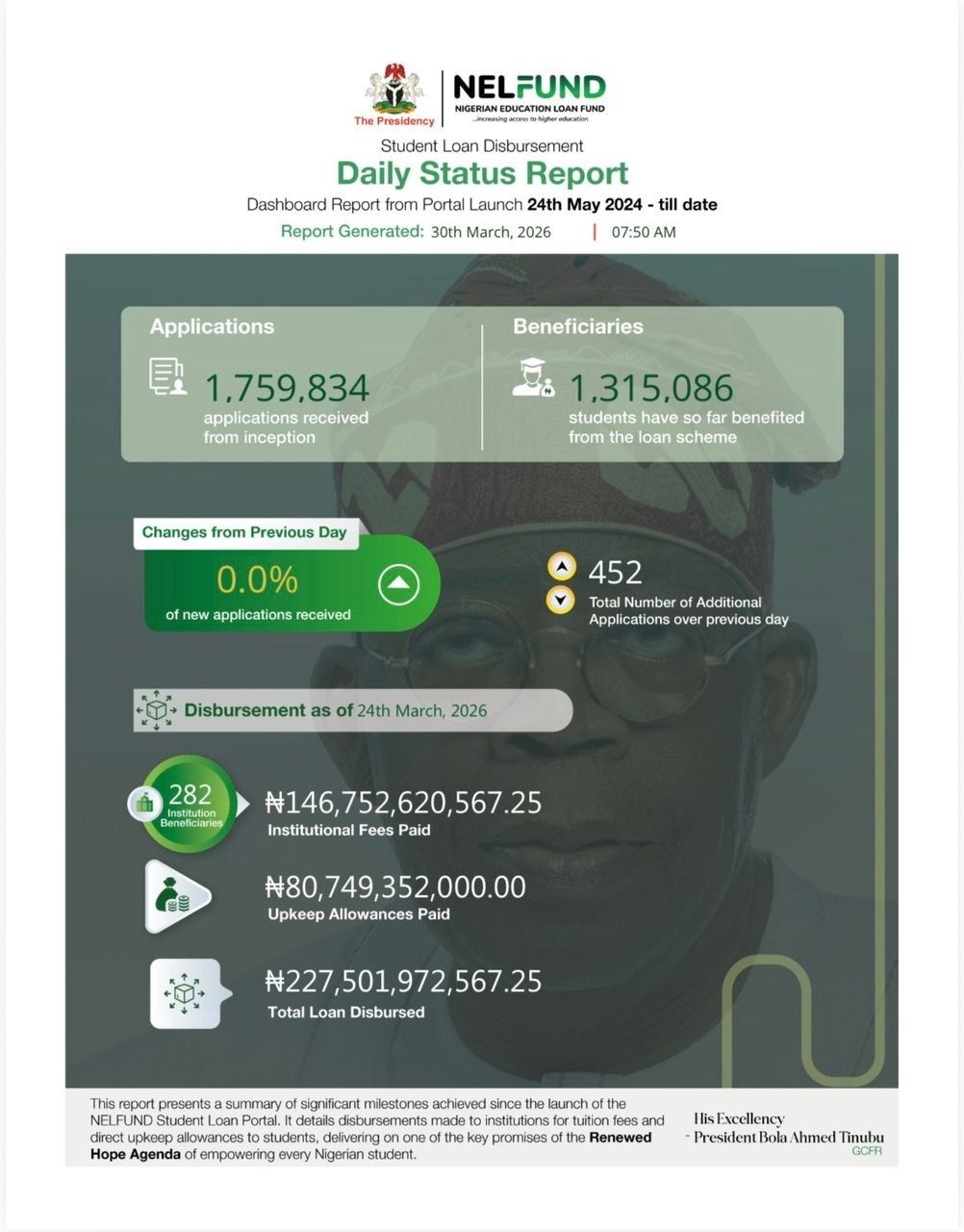
This suggests that within roughly three weeks, an additional N21 billion was released, while the number of beneficiaries increased by more than 150,000 students.
Breakdown of the latest figures shows that N146.75 billion has been paid directly to institutions as tuition fees, while N80.75 billion has been disbursed to students as upkeep allowances. This maintains the scheme’s dual-payment structure, designed to cover both academic and living expenses.
The number of participating institutions has also expanded. While earlier reports in January 2026 indicated that 263 institutions had received funds, the latest dashboard shows 282 institutions benefiting from the scheme, pointing to gradual inclusion of more schools.
NELFUND’s growth trajectory over recent months highlights the rapid scaling of the programme.
In January 2026, total disbursement stood at N161.97 billion, reaching 864,798 students from over 1.36 million applications.
By early March, that figure had risen to N206.29 billion for over 1.16 million beneficiaries.
The latest March 30 data now places total disbursement at N227.5 billion, with over 1.31 million beneficiaries, showing a consistent upward trend in both funding and reach within a short period.
Application volume has followed a similar pattern. From about 1.36 million applications recorded in January, submissions increased to over 1.73 million by early March and have now reached nearly 1.76 million
Daily application growth, however, appears to be stabilising.
The latest report recorded 452 additional applications compared to the previous day, with no percentage increase, suggesting a slowdown compared to earlier spikes, when daily increases exceeded 1,900 applications.
The scheme, introduced following the enactment of the Student Loans Act in 2024, is designed to provide interest-free loans to students in public tertiary institutions, covering tuition and living costs.
Disbursements are made directly to institutions for fees, while allowances are paid to students, a structure intended to ensure accountability and reduce misuse of funds.
Recent institutional-level data further illustrates the scale of implementation. For instance, Ignatius Ajuru University of Education received N990.4 million to cover tuition for 6,662 students under the scheme.
Earlier in the rollout, total disbursement stood at N116.4 billion as of October 2025, with 624,000 beneficiaries, showing that the programme has nearly doubled in size within five months.
The steady increase in disbursement and applications reflects growing reliance on the scheme as a financing option for higher education, particularly amid rising tuition and living costs.
With over 1.7 million applications recorded and more than N227 billion already disbursed, the NELFUND programme is emerging as one of the largest student financing initiatives in Nigeria’s history, both in scale and speed of expansion.


