
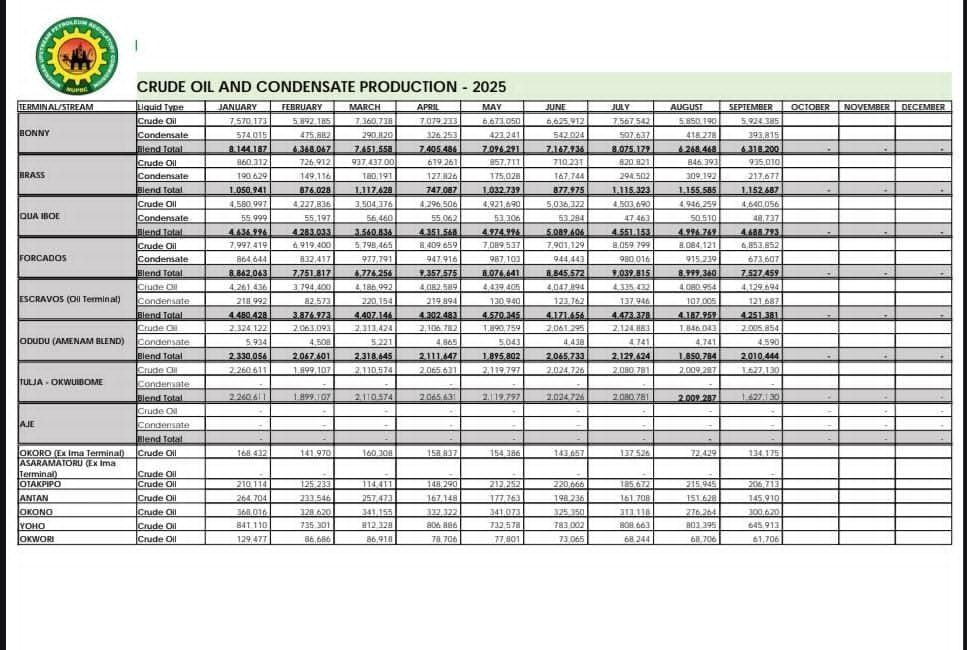
Nigeria’s crude oil and condensate production declined to an average of 1.581 million barrels per day (bpd) in September 2025, following industrial action by oil workers and scheduled maintenance at key facilities.
According to official figures released on Saturday, October 11, by the Nigerian Upstream Petroleum Regulatory Commission (NUPRC), the September output comprised 1.39 million bpd of crude oil and 191,373 bpd of condensate.
The Commission attributed the shortfall to a three-day strike by members of the Petroleum and Natural Gas Senior Staff Association of Nigeria (PENGASSAN), which led to temporary shutdowns at several production and export terminals across the country.
NUPRC further disclosed that turnaround maintenance carried out on two strategic facilities also contributed to the dip in national output during the review period.
Despite the disruption, the industry still recorded a total crude oil and condensate output of 47.43 million barrels for September, representing a modest 1.61 per cent year-on-year increase compared to the same month in 2024.
The figure marks a slight improvement over the 1.55 million bpd recorded in September 2024, suggesting incremental growth in the sector’s performance.
However, on a month-on-month basis, production fell by 3.09 per cent from the 1.63 million bpd achieved in August 2025.
NUPRC noted that average crude oil production for the month stood at 93 per cent of Nigeria’s OPEC quota of 1.5 million bpd.
During the month under review, the nation’s peak combined crude and condensate output reached 1.81 million bpd, while the lowest production level was 1.35 million bpd.
An analysis of the top eight production streams revealed that Forcados Blend accounted for 15.86 per cent of total production, followed by Bonny Light with 13.31 per cent, and Qua Iboe contributing 9.88 per cent.
Other major streams included Escravos Light (8.96 per cent), Bonga Crude (6.83 per cent), Agbami Condensate (4.94 per cent), Erha Crude (4.55 per cent), and Amenam Blend (4.2 per cent).
The NUPRC said it will continue to monitor production trends closely while working with stakeholders to minimise disruptions and ensure optimal output in the coming months.


