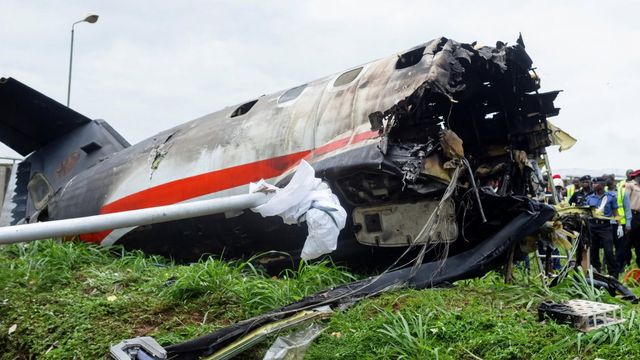
Nigeria is mourning another devastating loss of military personnel. But beyond the condolences, lowered flags and official assurances, the Nigerian Air Force aircraft crash in Ondo State demands questions that the country can no longer afford to postpone.
An ATR-42 aircraft, NAF 931, crashed in the Igbokoda area of Ilaje Local Government Area on Monday while undertaking a routine mission from Benin to Lagos. The Nigerian Air Force has confirmed that all 25 people aboard, comprising five crew members and 20 passengers, died. The victims included military personnel and civilians.
President Bola Tinubu has declared three days of national mourning and directed the Air Force to conduct a thorough investigation into the circumstances of the crash. The gesture is appropriate. The loss of 25 Nigerians, many of them serving their country, is a grave national tragedy. But grief cannot be the final response.
The first responsibility is to the families. The recovery operation must continue with urgency and dignity. The wreckage remains deeply submerged in difficult swamp terrain, with mangroves, creeks and murky waters complicating access. NEMA has deployed a specialised technical team, while the Ondo State Government has provided amphibious equipment to support the military and emergency agencies.
The fact that the recovery of the victims and wreckage has itself become such a difficult operation reinforces the need for properly equipped emergency-response systems. A country operating military aircraft over difficult terrain must have the capability to respond rapidly when something goes wrong. Search and rescue cannot depend on improvisation after disaster strikes. The more consequential issue, however, begins with the aircraft itself.
NAF 931 was delivered to Nigeria in March 2010 as one of two ATR-42 aircraft acquired under a $73 million contract that included training and logistical support. The aircraft was configured principally for intelligence, surveillance and reconnaissance and maritime patrol, although it could also undertake search-and-rescue and limited transport duties. It had therefore been in Nigerian service for more than 16 years when it crashed.
More significantly, aviation records reviewed by The ICIR show that NAF 931 spent almost four years at Rheinland Air Service in Mönchengladbach, Germany, where it underwent maintenance and had components, including its right engine, removed. It was still there in September 2024 and reportedly returned to Nigeria in late December that year. The nature of the work carried out, the components replaced or overhauled and the reason for the prolonged maintenance period have not been publicly established.
None of this establishes that maintenance caused the Ondo crash. That distinction matters. It would be irresponsible to pronounce an aircraft mechanically defective before investigators have examined the evidence. Yet precisely because the cause remains unknown, the aircraft’s maintenance history must form part of a serious investigation.
That investigation should also confront an uncomfortable record. A PUNCH review has identified at least 10 military aircraft crashes between 2021 and October 2026, resulting in at least 68 confirmed or presumed deaths. The incidents involved different aircraft and different circumstances, including combat operations, training, routine missions, casualty evacuation and post-maintenance flights. The figures do not demonstrate a single systemic cause, but they are serious enough to demand a broader examination of military aviation safety.
Nigeria’s armed forces increasingly depend on aviation. Aircraft are indispensable to counter-insurgency operations, surveillance, logistics, casualty evacuation and the movement of personnel. As insecurity has spread across large parts of the country, the operational burden on military aviation has correspondingly grown. That makes aircraft availability important. It also makes airworthiness non-negotiable.
The temptation in a security crisis is to measure military aviation primarily by how many sorties it can generate and how quickly aircraft can be returned to service. The more important question is whether those aircraft are being maintained to the standards required to keep their crews and passengers alive. This is why the emerging debate over maintenance funding deserves attention.
The African Democratic Congress has called for an audit of funds allocated and released for NAF aircraft maintenance. Citing official figures, the party said that by December 2025, N4.5 billion, or about 13.98 per cent of N34.71 billion budgeted for NAF aircraft maintenance, had been released. It contrasted this with the reported release of N20.27 billion, or 97.76 per cent, of the N20.74 billion allocated for presidential aircraft maintenance. Those claims should be independently verified as part of the investigation, rather than accepted as proof of a cause that has not yet been established. But even the question is legitimate.
Nigeria should not find itself in a situation where aircraft carrying soldiers into dangerous operational environments receive less reliable maintenance support than aircraft serving political executives. The safety of the President matters. So does the safety of the pilot flying a surveillance mission over the Niger Delta, the crew transporting personnel between operational bases and the soldiers being carried aboard. The investigation must therefore go beyond the cockpit.
It should establish the aircraft’s complete maintenance history, its airworthiness status before the flight, the nature of its most recent overhaul, the condition of its engines and critical systems, the qualifications and duty schedules of its crew, the weather and flight conditions, the communication failure reported before the crash, and every decision made before the aircraft took off.
It should also establish who was responsible for certifying the aircraft for service and whether every required inspection was completed.
There is another question that deserves a clear answer. Initial statements about the number of people aboard the aircraft differed. The President’s first statement referred to 25 passengers and seven crew members, while the Aviation Minister initially reported 32 occupants. The NAF subsequently confirmed a manifest of 25 people, comprising five crew members and 20 passengers. The discrepancy may ultimately have a straightforward explanation, but the public deserves a clear account of how the error occurred.
Transparency matters particularly in a military investigation because the public cannot independently examine the aircraft, its records or the operational decisions surrounding the flight.
There is also a question of institutional independence. The Nigerian Safety Investigation Bureau has said the crash falls outside its statutory mandate because it involved a military aircraft, although it can participate if formally invited by the military. That arrangement may be legally established, but it should not become a reason for a closed investigation.
The NAF has every right to protect legitimate military information. It should also recognise that an investigation into a fatal crash involving public assets and public funds is ultimately an exercise in public accountability. Where information can be released without compromising national security, it should be released.
The country has heard too many condolences after military aviation disasters. Families deserve more than assurances that their loved ones died in the line of duty. They deserve to know whether their loved ones were placed in an aircraft that had been properly maintained, properly certified and properly operated. The Nigerian Air Force deserves the same accountability. Its personnel are not expendable simply because they serve in uniform.
The men and women who fly, maintain and travel aboard these aircraft are among the people Nigeria relies on to defend its territorial integrity and protect its citizens. Keeping them safe is therefore part of national security itself.
The Ondo crash should result in more than an investigation into one aircraft and one flight. It should trigger a comprehensive review of military aviation safety across the services, including maintenance funding, procurement, aircraft availability, crew welfare, technical capacity, inspection regimes and emergency response.
If NAF 931 failed because of a mechanical defect, Nigerians must know. If it failed because of human error, the facts must be established. If weather or some other operational factor was responsible, that too must be made clear. And if the investigation finds that none of these was responsible, the evidence should say so.
The country should resist the familiar cycle in which tragedy produces mourning, mourning produces promises, and the passage of time produces forgetfulness. The 25 people who died in Igbokoda deserve better than that.
Nigeria’s military aviation system must become safer, more transparent and more accountable. The investigation into NAF 931 is the immediate test. The reforms that follow it will determine whether the country has learnt anything from another devastating loss.