
By Samuel A. Betiku
A poem called Beyond Music, performed at an evening of that name, has to answer an awkward question: where, exactly, is beyond? Olugbenga Fayehun answers in the opening lines of his piece.
…a place where sound stops, but sense starts,
where rhythm rests, but meaning marches,
where melody fades, but memory amplifies.
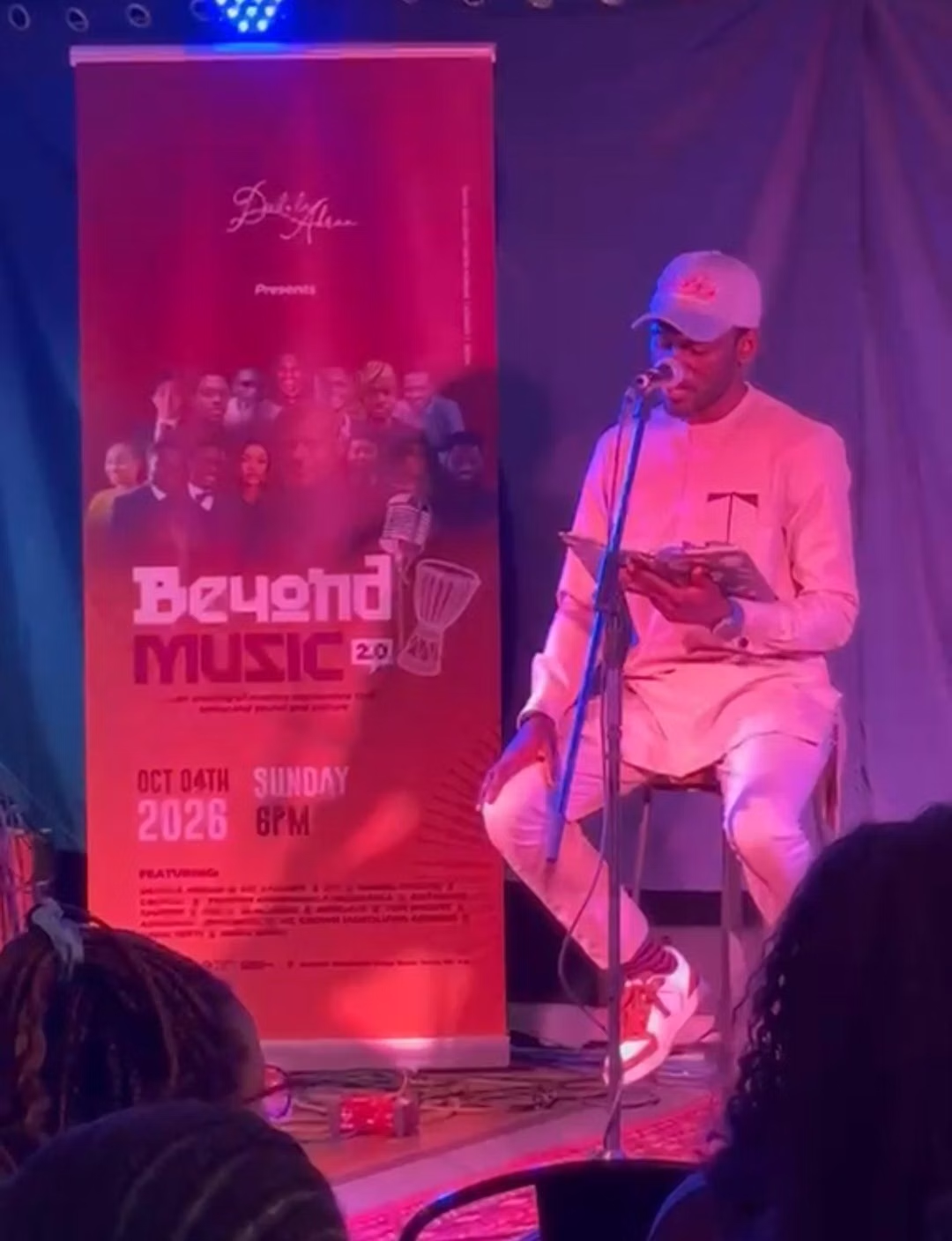
Music is a vehicle here, an echo that carries meaning beyond the sound itself. Its deepest power lies in what it makes us reflect on after the music has ended, and the event suited this claim. Beyond Music began in Derby as a night in which music, poetry and comedy share a stage on equal terms, and its first edition was praised for bringing African and diasporic artists into one room. Gbenga performed at the second edition. A poem exploring the power of music beyond sound could hardly ask for a better setting than a mixed audience on a mixed bill, listening to a poem about what might unite them. From there, the poem grows practical.
Beyond music, there is a beat you don’t hear, you feel.
A pulse that doesn’t need percussion to prove it’s alive.
A tempo that doesn’t need a track to stay on track
The beat that matters here is not necessarily audible; it is a pulse sustained by meaning rather than percussion. This becomes clearer in what appears to be the poem’s central rebuke: creativity, Gbenga says, “isn’t just what you play, it’s what you portray / It’s not just the note you hit, it’s the notion you hold.” There is a possible critique here of music that privileges sound or spectacle over substance. Music, in Gbenga’s account, ought to be an active force, a notion motioning towards something. Before an audience as varied as this one, the next line reads almost as an instruction: “not just the bars you spit, but the boundaries you split.” Music should do more than entertain; it should challenge racial and social divisions that keep people apart.
Gbenga further explores what lies beyond music through what initially seems like a contradiction. He speaks of movement beyond music “that doesn’t need choreography to make meaning move.” What kind of movement is this? It is the movement of meaning itself, the motion of a notion. The poem moves from this abstract idea of meaning to something more tangible in its treatment of culture:
Beyond music, there is culture,
not just the kind you inherit, but the kind you ignite.
This feels especially apt in a setting that brings together artists and audiences from different cultural backgrounds. I dare say that the idea of culture here also presents a way to view the continuing struggles of Black lives. It suggests that culture is not only shaped by the historical and social bias we have inherited, but by the retelling and the reshaping we seek to achieve through the music of words. How fitting, then, to redefine culture as “not just what we sing, it’s what we survive.”
A performance like this then becomes a form of resistance, helping to foster a culture of unity. The communal intent that outlasts the music is exactly “the art we carry in the quiet corners of our courage, / the colours we wear when the world feels colourless.” This opens up another vista onto what lies beyond music: the need for freedom of expression, regardless of race or social status.
Beyond music, there is expression.
Raw, restless, resonant
Gbenga now turns to one of the means by which expression acquires its force: wordplay. Throughout the performance, he embellishes his argument with lucid verbal turns, but here he brings the device into focus. “A phrase flips,” “a line lifts,” and “a poem runs until the meaning shifts.” He treats wordplay as both a thing to be named and an action to be performed. The response of the audience during this action is noteworthy: a couple of listeners respond with an “uhm,” an audible sign of engagement with the verbal play. The moment suggests how the music of language can travel beyond the speaker, making the listener part of the experience. It is how breath, as Gbenga puts it, becomes a bridge.
Worthy of note, too, is how Gbenga calmly speaks while seated, with the only evidence of ‘force’ reflected in the intermittent stress on some phrases. He seems to trust the inherent strength and musicality of his words. While performance poetry often involves a mixture of music and motion, Gbenga trusts the music to do the motion. This offers another perspective on the previously referenced line: the movement beyond music “that doesn’t need choreography to make meaning move.”
The final movement of the poem addresses what exists beyond music on a corporeal level. The performance began by placing meaning beyond music, with the unifying intent of the sound as the force that outlives the sound. At the end of the performance, Gbenga brings us to the voice, to “the one carrying stories that never made it into songs, but still deserve a stage.” This line carries particular weight from someone who has given stories a stage as a director, as Gbenga did with The Parliament in Abeokuta in 2022.
Again, the figure of the one carrying those stories seems to embody Black lives whose stories have been suppressed by racial prejudice and historical injustice. In the end, what matters beyond the sound is not simply the message that survives it, but the human who needs to be heard. Gbenga, in a way we are not likely to forget, leaves us with the possibility that music can help us recognise our shared humanity even when our histories and circumstances divide us.
Samuel A. Betiku is a writer from Ondo, South-West Nigeria. He won the Eriata Oribhabor Poetry Prize in 2020, was named a co-winner of the Folorunsho Editor’s Poetry Prize in 2024, and was a finalist for the 2024 Rhysling Award. His work has appeared in Rattle, The Offing, The Temz Review, Frontier Poetry, Trampset, The Christian Century, Strange Horizons, Agbowó, The Deadlands, and elsewhere
Olugbenga Fayehun is a multidisciplinary arts practitioner whose work spans poetry, spoken word, drama, artistic programming and creative leadership. His practice is rooted in storytelling, cultural expression and audience engagement, using performance and the literary arts as tools for dialogue, reflection and social connection.
As a poet and spoken word artist, he has performed across Nigeria and the United Kingdom. His artistic credits include appearances in The Parliament and The Verdict in Nigeria, as well as Beyond Music, Ìlú, and Keys of Heritage in the United Kingdom. Through these performances, he has explored themes of identity, heritage, belonging, community and contemporary social issues, creating work that resonates with diverse audiences across cultural contexts.
Olugbenga previously served as Head of Creative Arts at Creative X, where he led a multidisciplinary unit comprising drama, dance and spoken word divisions. In this role, he oversaw artistic programming, talent development and project delivery, guiding emerging artists while fostering collaboration across multiple creative disciplines. His leadership contributed to the development of platforms that enabled artists to create original work and engage audiences through performance, cultural events and community-centred artistic initiatives.
Alongside his performance practice, he develops independent creative projects centred on storytelling, artistic expression and cultural engagement. His work is driven by a commitment to nurturing creative talent, expanding access to the arts and using performance as a catalyst for meaningful conversation and social impact.
Holding a Master’s degree from Swansea University, Olugbenga continues to contribute to the arts through creative practice, artistic leadership and interdisciplinary collaboration. His vision is to build platforms that empower artists, celebrate cultural identity and strengthen connections between communities through the transformative power of the arts.


