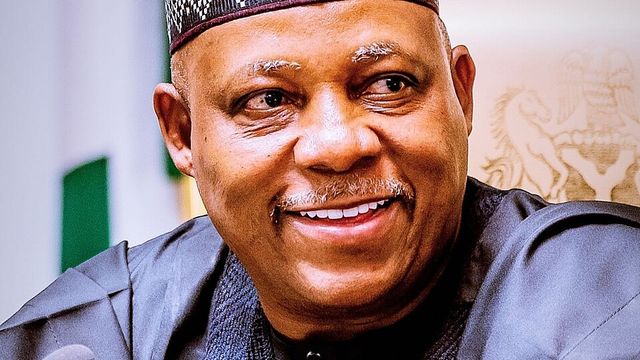
Vice President Kashim Shettima has called for holistic approach in tackling humanitarian crises and ensuring durable solutions.
The Vice President made the appeal at the United Towns Agency (UTA) for North-South Cooperation International Humanitarian Award and Lecture, and the unveiling of UTA’s Social Centre on Friday in Abuja.
The Vice President, represented by Mrs Zubaida Umar, Director-General of the National Emergency Management Agency (NEMA), stressed the need for collaborative efforts to protect vulnerable communities from harm.
Shettima said, “Our task is to build the architecture of justice that is strong enough to break the collapse of trust and build security capable of protecting every person, and community from harm.
“Conflict teaches us that violence never remains the private burden of a place where it begins.”
According to him, a village that is abandoned to terror becomes a corridor of displacement, while a model community surrendered to hunger becomes a market to traffickers.
He also said that communities that are kept away from others often discover that the fire they dismissed at a distance could find its way to their own door.
“Humanitarian responsibility is an act of enlightened self-preservation, as much as an expression of compassion:
“This is where UTA can connect communities across borders, strengthen dialogue and mobiles humanitarian cooperation,” he said.
In his remarks, Dr Bernard Doro, Minister of Humanitarian Affairs and Poverty Reduction, commended UTA for its initiative to commemorate the World Humanitarian Day celebrated globally on Aug. 19.
According to him, the focus is to strengthen global solidarity and empower localities, as humanitarian needs globally are worsening.
“We have at the moment over 300 million people in need of humanitarian assistance worldwide across over 72 countries of the globe.
“Unfortunately, the funding is shrinking. So, it calls for more solidarity.
“Let us use opportunities like this to encourage funding for humanitarian needs because the needs are increasing, it is important we observe our laws and ensure they are protected,” Doro said.
In a keynote address, Zamfara Governor, Dauda Lawal, represented by Alhaji Mouktar Lugga, his Chief of Staff, said humanitarian actions should be centred more on protecting lives and upholding human dignity.
“The humanitarian imperative must, therefore, be connected to the development imperative. We must increasingly think in terms of continuum in which immediate relief protects life and early recovery restores essential services.
“Livelihoods restore economic independence, social protection reduces vulnerability, peace-building reduces thrust, reconstruction restores communities, and development creates conditions for people to live securely and productively,” Lawal said.
UTA-Nigeria Country President, Amb. Abigail Amalaha, disclosed the event was organised to honour those who stood in the gap of humanity and renew collective commitment to humanitarian services.
According to her, UTA Social Centre is a promise made and kept, and would serve as a hub for vocational training, healthcare support, and welfare service for vulnerable groups.
Dr Eya Essif, UTA Global Secretary-General, said Nigeria occupied a very special place in UTA-African vision, saying Nigeria was at the heart of the conversation, and must also be at the heart of the action.
“Over the years, UTA has supported initiatives in Nigeria across key areas of human and sustainable development, including health, education, social development, youth, empowerment, and community empowerment.
“However, beyond sectors and programmes, there is something much more important than human beings, because behind every development project, there is a life, family and future waiting to be built,” she said.
News men reports that the event, with the theme: “Strengthening Global Solidarity and Empowering Local Communities” attracted government, traditional institutions, civil society and the private sector leaders.