…as FG targets #1,350 ex-gantry price, moves to harmonize freight taxes with States
The Federal Government has warned that a return to petrol subsidy could weaken the naira to about ₦3,000 to the dollar within months and push petrol prices above ₦2,000 per litre.
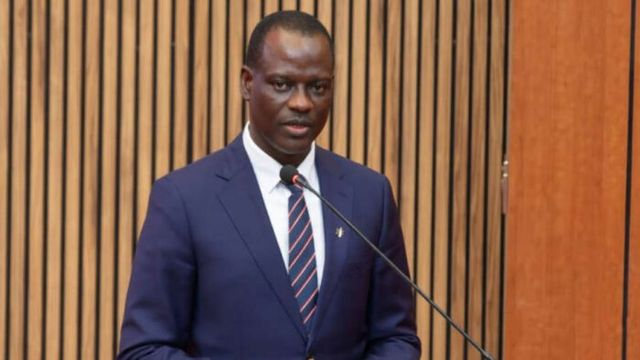
Minister of Finance and Coordinating Minister of the Economy, Prof. Taiwo Oyedele, gave the warning on Thursday in Abuja while addressing journalists on the rising cost of fuel and proposals to reintroduce subsidy.
Oyedele said although the government recognised the pressure higher fuel prices were putting on households and businesses, returning to a blanket subsidy would transfer the burden to government finances and ultimately worsen economic conditions.
The Minister also revealed that the government is negotiating a ₦1,350 per litre ceiling on the ex-gantry or landing cost of petrol under a proposed price modulation arrangement.
Oyedele said the mechanism would allow refiners and importers to recover higher costs later when market conditions improve, while the ceiling would be reviewed monthly.
He clarified that the proposed arrangement was neither a subsidy nor a price control.
On the proposal being pushed by leading opposition candidates for a production subsidy, he noted that it would amount to a consumption subsidy because it would involve discounting crude and passing the discount through to the pump.
“However it is described, a subsidy must be financed,” Oyedele said, adding that it would ultimately be funded through delayed salaries and pensions, higher taxes or money creation.
According to him, Nigeria consumes about 50 million litres of petrol daily, meaning that returning petrol to its pre-reform price would cost more than ₦20 trillion annually, before accounting for higher consumption and smuggling.
He added that fixing petrol at ₦500 per litre would cost more than ₦16 trillion annually.
Oyedele said the amounts were nearly equivalent to the total funds shared from the Federation Account among the three tiers of government in 2025.
He said a subsidy would also expose the government to higher fiscal risks because crude oil, freight and refining inputs are largely priced in dollars.
“If the pump price is fixed while crude, freight and the exchange rate all move, the risk does not disappear. It moves onto the public balance sheet,” he said.
The Minister revealed that subsidy removal has released ₦15.8 trillion to the Federation Account between June 2023 and December 2025, with ₦10.4 trillion going to states and local governments.
He noted further that 27 states were unable to reliably pay salaries in May 2023, compared with the current situation where no state was in that position.
Oyedele warned that reversing the reform could trigger a chain of weaker government revenue, a sovereign credit downgrade, higher borrowing costs, capital flight, falling reserves and further naira depreciation.
He said the ministry estimated that the exchange rate could approach ₦3,000 to the dollar within months if subsidy was restored, while subsidised petrol could cost at least ₦2,000 per litre.
The minister also said Nigeria’s current petrol price had been affected by a global supply shock, with Brent crude rising from about $70 per barrel before the conflict to more than $100 currently.
He said petrol had consequently risen from about ₦830 per litre to an average of about ₦1,400 per litre.
Despite the increase, Oyedele said Nigeria had not experienced widespread fuel queues, with petrol remaining available across all states.
“In a crisis of this kind, availability is the first form of affordability,” he said.
Oyedele said the government had instead relied on measures including domestic refining, tax and duty waivers, naira-for-crude arrangements, tighter regulatory oversight and cheaper alternatives such as compressed natural gas.
He said tax and duty waivers on petroleum products currently save consumers between ₦400 and ₦600 per litre, with more than ₦3.3 trillion in petrol taxes and duties waived in the year to September 30, 2026.
The minister said more than 120,000 vehicles were now running on CNG, supported by more than 400 conversion centres, 96 refuelling stations and 18 liquefied-to-compressed natural gas stations.
He added that more than 550 CNG buses had been deployed, with fares falling by between 30 and 50 per cent in areas where the buses operate.
Oyedele said the government would continue to consider targeted measures to reduce the impact of higher fuel prices without returning to a blanket subsidy.
Among the measures announced are a 30-day margin discount on petrol sold at NNPC stations, with priority for public transporters; forward crude sales to domestic refineries; faster CNG deployment; increased cash transfers and subsidised credit for vulnerable households and small businesses; and action against illegal road levies that increase transport and logistics costs.
He further revealed that the government is also considering an excess profit tax on operators deemed to be taking undue advantage of consumers, with proceeds potentially directed towards transport support and vouchers for low-income earners.
Oyedele said the Federal Government was developing a National Strategic Fuel Reserve that would allow refined products to be released during major supply disruptions or periods of hoarding.
He said any proposal to reduce petrol prices must demonstrate its cost, how it would be sustainably funded and the pump price it would ultimately deliver.
“We will engage in good faith with any proposal that shows its arithmetic,” he said.
Oyedele said the government’s objective was not to reverse the subsidy reform but to ensure that its benefits reached more Nigerians while cushioning the immediate impact of higher energy costs.
He added that the Federal Government was working on a broader package of fiscal measures aimed at bringing inflation down to single digits sustainably, with further details expected in the coming months.