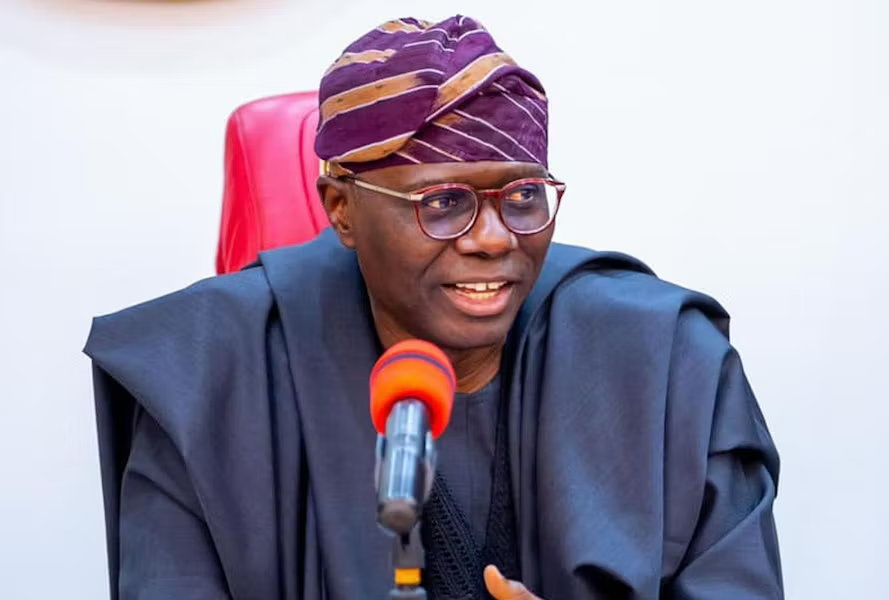
The Governor of Lagos State, Mr Babajide Sanwo-Olu, on Friday commissioned Nigeria’s first integrated energy hub in Oshodi.
Speaking at the commissioning, the Governor described the facility as a significant milestone in the country’s transition to cleaner, more affordable, and sustainable energy sources.
The Governor launched the newly built IBILE Oil & Gas Corporation (IOGC) Oshodi Integrated Energy Hub on the Apapa-Oshodi Expressway, Lagos.
Speaking, he stated that the project, developed by IBILE Oil and Gas Corporation, exceeds the scope of a typical filling station, integrating multiple energy solutions under one roof to bolster the future of transportation and economic growth.
The event was also attended by top government officials, regulators from the oil and gas sector, industry stakeholders, community, religious and political leaders, who lauded the project as a major step forward for Nigeria’s clean energy transition and alternative fuel infrastructure development.
The facility offers Premium Motor Spirit (PMS), Automotive Gas Oil (AGO), Liquefied Petroleum Gas (LPG), Compressed Natural Gas (CNG), electric vehicle (EV) charging stations, and solar power, making it the first of its kind in Nigeria.
Speaking at the event, Governor Sanwo-Olu said that the inauguration marks an important step in Lagos’ aim to lead in innovation and infrastructure development while supporting the Federal Government’s energy transition agenda.
“Many people may wonder why a Governor would personally commission a filling station. This is not just any filling station. It is an integrated energy hub that points to the future of mobility and energy in Nigeria,” he said.
Governor Sanwo-Olu explained that the facility responds practically to the nation’s changing energy needs and offers motorists and businesses cleaner, more affordable alternatives.
The Governor highlighted Lagos’ ongoing investments in infrastructure that promote economic growth and improve residents’ quality of life, emphasising that affordable transportation remains key to sustaining commerce in Africa’s largest city.
He revealed that Oshodi was chosen deliberately for the project due to its strategic significance as one of Nigeria’s busiest transport and commercial corridors, where thousands of commuters and transport operators rely on dependable energy infrastructure daily.
Governor Sanwo-Olu also praised President Bola Tinubu for his leadership in accelerating the adoption of compressed natural gas and alternative energies through the Presidential CNG Initiative, stating that the programme is gradually transforming Nigeria’s energy landscape.
He urged federal regulatory agencies and industry stakeholders to collaborate closely with state governments in replicating similar projects nationwide, stressing that the energy transition should be regarded as a matter of national development rather than a political issue.
He expressed confidence that the energy hub would lower transportation costs, boost economic activity, create jobs, and attract more private investments into Lagos.
Governor Sanwo-Olu commended IBILE Oil and Gas Corporation’s management for pioneering this initiative, describing it as evidence that government-owned enterprises can innovate while delivering both commercial and public benefits.
He reaffirmed Lagos State’s dedication to attracting investment and assured stakeholders of continued support for projects fostering sustainable development and enhanced public infrastructure.
Speaking earlier, the Managing Director of IBILE Oil and Gas Corporation, Mr Temitayo Gbajumo, called the facility Nigeria’s and possibly Africa’s first integrated energy hub.
He stated that the project is part of the corporation’s plan to establish 19 CNG stations across Lagos, supporting the Federal Government’s alternative energy programme.
Gbajumo said the Oshodi hub is unique because it combines CNG, LPG, EV charging, PMS, and AGO dispensing points within a single location, offering motorists a broad spectrum of energy options.
He added that four CNG stations are operational in Lagos, with another 12 in development.
“This facility is designed to dispense between 200 and 300 vehicles daily for PMS and AGO, while the CNG section has the capacity to supply about 7,000 Standard Cubic Metres of gas every day,” he explained.
He said that a vehicle conversion centre at the hub enables motorists to convert petrol-powered vehicles to CNG, with the company subsidising the cost, which is about ₦700,000 for the conversion kit and installation.
Gbajumo noted that the objective is to make switching to cleaner, affordable energy easier for Lagos residents.
He disclosed that four additional CNG stations will be operational before the end of October, with six more under construction, expecting all 19 stations to be completed before year-end.
He disclosed that existing stations in Agege and Ogudu already record high patronage from tricycles, cars, and trucks, with each dispensing around 5,000 Standard Cubic Metres of gas daily.