
By Izang Alexander Haruna
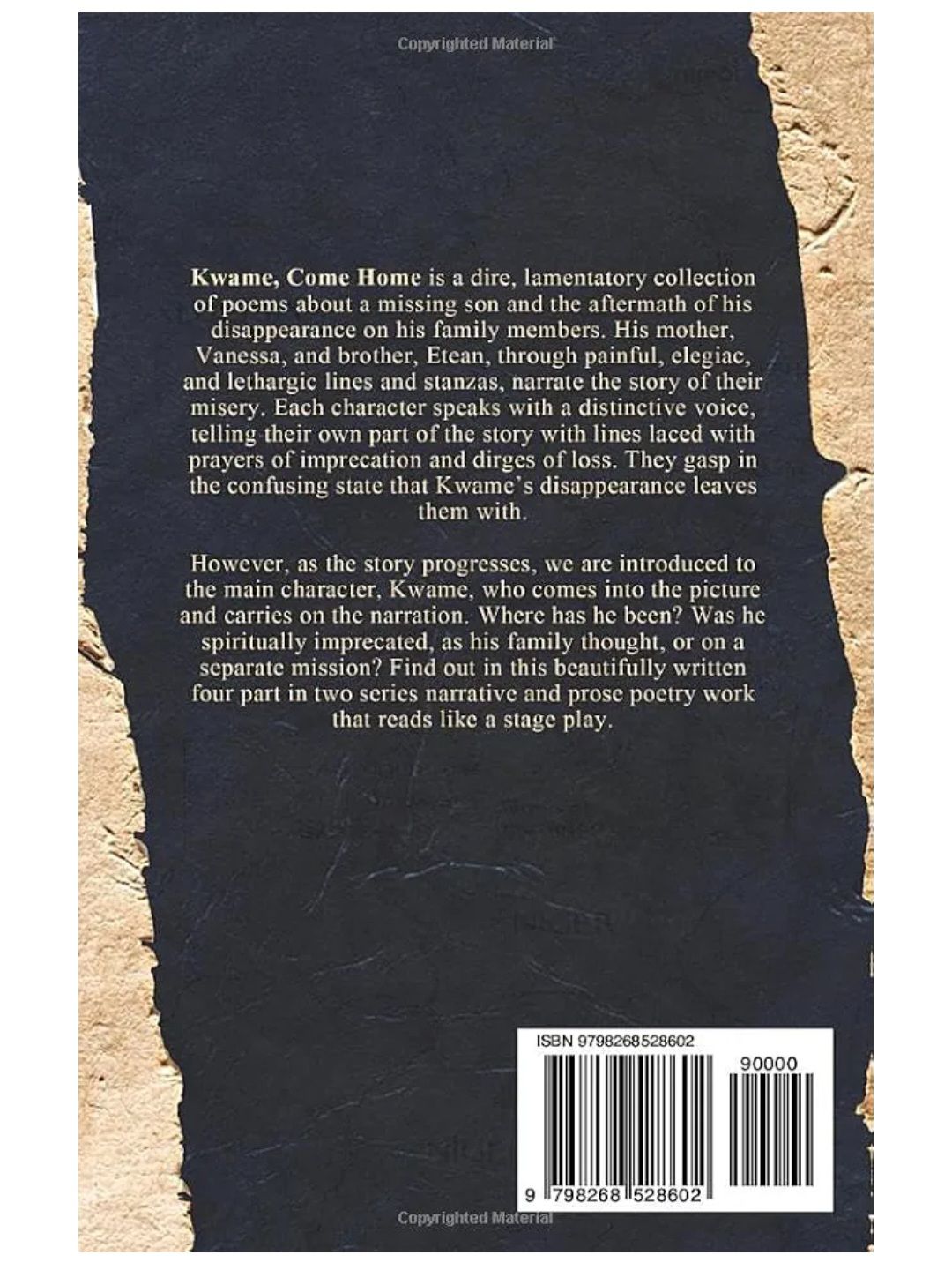
Kwame, Come Home is a rare breed collection intended to spread in four parts, the first volume is subtitled ‘Grief’ and runs a total of 111 pages and constituted of 23 poems. It is a rare breed because it blends poetry and narrative into a story of loss, waiting, and survival. Following the long tradition of poetic works such as The Illiad, Odyssey, Aeneids, the Divine Comedy amongst others. It is not just a western thing, Africa, being traditionally given to oral poetry which is essentially narrative in character, has some documented collections that speak to similar style. Among these include Gabriel Okara’s The Fisherman’s Invocation, Okot p’Bitek’s Song of Lawino, Romeo Oriogun’s How to Survive the Fire, and Ben Okri’s A Fire in My Head. Peter Okonkwo joins this elite few with a collection that centres the grief of a mother, Vanessa, whose son – the titular character Kwame – disappears without a trace, leaving in his wake a silence that grows heavier with time.
The collection is structured in two clear but unequal movements. The first part, composed of thirteen poems, is rooted in grief. Maternal Grief is laid bare as provided for by the opening stanza of the first poet titled ‘A Hunt for Kwame’s which reads “In spite of much ado / and the endless endurance / of Vanessa’s uneasiness, / she resolved to hunt for her son” (p. 11). Vanessa speaks with a voice filled with pain, longing, and desperation. Her situation is well exposed by the narrative thus: “Confusion, depression, and aching / anxiety filled her fragile soul. / “Should I not rather die,” she cried, / “than suffer the scourge of a missing son?” (p. 11).
Vanessa’s grief is not quiet. It is active. She searches. She prays. She consults seers. She turns even to practices outside her faith, not out of confusion but out of desperation. The poems capture this restlessness well. The cries are seen in the lamentations, the poem ‘Vanessa’s Dire Lamentations’ pierces the heart, a portion reads: “Was I created to see hell on Earth at all times? / My husband had just recovered from a dreadful illness months ago; / and now, my beloved son is nowhere to be found. / Those who should have helped me find him tarried and ridiculed my sort of misfortune. / My tears become the only water / available to quench my droughty thirst. / I’ve run from fire to continuous trouble” (p. 26). Within the same long poem she prays with every possible fibre of her being: “Dear God, / attend to the tears / of my tearing eyes, and restore / to me the joy of motherhood” (p. 30). It is maternal grief appealing for divine mercy. This grief pushed her, despite her Christian faith, to soliciting the divine help of other gods like Ogun, Orinsala, but to no avail.
Alongside her in this grief is Etean, Kwame’s brother, who also shares in this burden. Together, they try to make sense of an absence that offers no explanation. The explanation they fall to is the mystical, believing there’s an evil hand at work, hence Etean turns imprecatory in saying: “Your mother’s tears over your life shall not go unrewarded, Kwame. / Those who used sand to fight against you shall not succeed on land. / And if it were to be water, accursed to contend with you, water shall not ease their lives. / Whatsoever evil altar used against your being shall fail. / Let breath cease from the nostrils of whoever troubles your breath” (p.43). Etean will add in same poem, almost immediately: “My maledictory prayers and the / tears of your poor mother, / Vanessa, shall avail for you” (p. 44). A mother who has no closure will try everything. Her pain stretches across years, and the weight of waiting begins to show in the tone of the lines, which often feel slow and tired, as though grief itself has drained her strength. So intense is Vanessa’s grief that the narrator is moved to join in pleading on her behalf: “Come, Kwame. / Restore the joy of your anxious mother. / Your return will bring back her stolen peace. / Kwame—please, come home” (p. 14).
What stands out in this section is the emotional honesty. The language is direct. The sorrow is not hidden. At times, however, the intensity leans heavily into repetition. The titular poem is evidence for the point just made. It is fitting as a metapoem, it bears almost everything the other poems within the section have said but with more poetic precision. It presents the anguish of a depressed mother, a moving stanza which crystallises this maternal grief reads: “I thought a mother / should have effective / power over her child. / Did you not suckle my / breast and through my / vagina, passed out? / You lived in my womb / for months and rested / on my back for years. / If I command your coming home, / should it not be so?” (p. 47-48). This explains the meta-biological affinity between mother and child. The kernel of maternal concern and solicitude. For all its distortion and bitterness, her grief has room for optimism; the narrative places her disposition, via the poem ‘Soliloquy’ thus: “I’ve searched my strength out to exhaustion. / Scoured the land and the sea to no avail. / If he’s alive, he will definitely come / home someday” (p. 59). The soliloquy is quite brief, not commensurate with the depth of grief, but it redeems an otherwise ambitious poem that didn’t deliver as promised.
The second part turns the narrative to the other page. Here, the deadlock is broken. We begin to see where Kwame is and what led to his disappearance. This section works like a flashback, represented by the opening narrative ‘The Ancient Phone Call’, but it does feel like a revelation. Kwame is not lost in a mystical sense, as his family fears. He is on a journey. A dangerous one. To quote the horse’s mouth: “treacherous journey” (p. 100). Together with his friend Jide, he leaves home in search of a better life. What follows is the experience of this treacherous journey, a familiar but still disturbing path. The crossing of the Sahara. The harsh conditions in Libya. The uncertainty and fear of the Mediterranean. The ten poems of the section are highly repetitive, being basically the perspectives of Kwame and Jide.
The precarity of the experience is seen in these brief lines: “We then began our journey, / exiting Chad to the Niger Republic, / covering 2,473.6 km in a 56-hour journey. / We got to the Niger Republic, / and there our problem began, / like the slow cracking of a heart / under the weight of its own hope” (p. 78-79). It is the section with stronger poetry in terms of technique, especially the Jide poems that evoked concrete imagery. In Jide’s song of regret, titled ‘I Should Never Have Left’ we read this auspicious yet evocative lines: “We became a portrait of sorrow— / caves carved from misery, sculptures hewn from despair— / undocumented travelers on a road without a map / and no promised end” (p. 84). This is a powerful depiction of what the journey made of the boys. It is repeated or better still reiterated in Jide’s sonorous song of shame titled ‘We Were a Royal Portrait of Sorrow.’ If there’s a poem that encompasses the rest then it is Kwame’s extensive lamentations titled ‘Agadash Nights’, it is the harmonising piece – saying much with little words.
This part of the collection expands the story beyond the home. It places Vanessa’s grief within a larger reality. Many young people leave. Many do not return. Some are lost in transit. Some survive but are changed in ways their families may never fully understand. Bringing Kwame into the narrative ensured the collection balanced the emotional weight of the first part. The reader is no longer left only with questions. There is context, there is explanation. Yet, even with this, the tension remains. Will he return? Can he return? As such, I can say that the most important poem in the entire collection is ‘Will Vanessa Ever Find Rest?’ We await the next volume.
One of the strengths of the collection is its form. It reads like a stage play at times, with different voices taking turns. This gives it a sense of movement and presence. The characters are not distant. They speak directly, and this draws the reader closer into their world. The blend of poetry and prose also works well even if it can easily turn off a reader who prefers to do the hardwork of deciphering. The poetic lines carry emotion, while the narrative sections provide clarity. Together, they create a story that is both felt and understood.
If anything, Kwame, Come Home is about absence. But it is also about connection. A mother’s love does not end because her son is gone. It stretches across distance, across time, across silence. At the same time, the book quietly comments on migration. The search for a better life is shown not as a simple choice, but as a risk filled with danger and uncertainty. If there is a weakness, it lies in the weight of its own emotion. The grief, though powerful, could benefit from more shifts in tone. Still, this does not take away from the sincerity of the work.
There is a strong echo of Niyi Osundare’s poem “Akintunde, Come Home” in Peter Okonkwo’s Kwame, Come Home. The titles sound alike. The reason for calling the child back is also the same. In both poems, someone is asking a son to return home from a dangerous place. But there is a clear difference. In Osundare’s poem, we do not know if it is the father or the mother speaking. The voice sounds calm, like advice. It warns the child about the world and asks him to come back before it is too late. There is care in the words, but the pain is not deep. In Okonkwo’s collection, it is not like that. The voice is clearly a mother’s voice. And the tone is heavy with grief. This book comes many years after Osundare’s poem as contained in the collection Village Voices, yet it feels darker. Here, the call is not just a warning. It is a cry. It is a mother who has waited too long and is already hurting.
BIO:
Izang Alexander Haruna is a poet and critic, with interest in African philosophy, culture and religion. He was shortlisted for E.E. Sule/Sevhage Prize for African Literary Criticism (2024). His debut publication is a critical work: Letters to 42 Writers (2024) and the Chapbook In a Man’s Body (2025). His reviews and essays have appeared in The Nigeria Review, ANA Review, Nesting in the Rock Anthology (ANA Plateau), Guardian Newspaper, Business Sunday News, Con-Scio Magazine, amongst others. Has appeared as panelist at Benue Book and Arts Festival, Plateau Literary Festival, Jos Bookfair, AfrikaWrites Series. Currently pursuing postgraduate studies in Philosophy of Education at the University of Jos.
Buy here: Amazon US: | Amazon UK:


