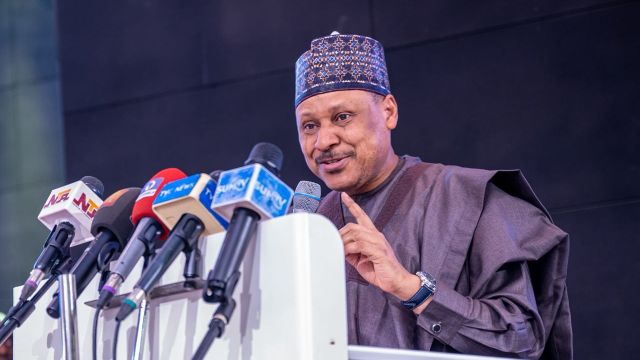
The Minister of Information and National Orientation, Mohammed Idris, has called on public relations practitioners to prioritise mentorship and ethical communication to sustain the profession.
Idris made the call on Saturday in Kaduna at the maiden Bashir Adamu Chedi Annual Memorial Lecture and Annual General Meeting of the NIPR Kaduna State Chapter.
The lecture with the theme, “Bridging Generations: Strengthening Public Relations Through Mentorship”, was organised in honour of late Mallam Bashir Adamu Chedi.
The minister described Chedi as a colleague, brother and friend whose contributions to public relations and mentorship left an enduring legacy.
Idris said Chedi served as secretary and chairman of the NIPR Kaduna State Chapter and later became a Fellow of the institute.
He added that Chedi also served on the NIPR Governing Council and chaired its Chapters Relations Committee, while distinguishing himself in corporate communication.
“His greatest legacy was not the positions he occupied, but the people he influenced, younger practitioners he encouraged and professional values he represented,” Idris said.
He said no profession could endure, if every generation was forced to start afresh, stressing the need to transfer experience and preserve institutional memory.
According to him, mentorship has become more important as communication technology changes rapidly, with social media, artificial intelligence and manipulated content reshaping information dissemination.
“Public relations cannot simply be about publicity. Our real business is trust,” Idris said, stressing truth, credibility, integrity and responsibility.
He said technology could change, but the foundations of public relations must remain anchored on truth, credibility, integrity and respect for the public.
The minister urged young practitioners to value the experience of senior professionals, while encouraging older practitioners to embrace innovation and support emerging professionals.
Idris expressed hope that the memorial lecture would become an enduring platform for mentorship, professional reflection and the advancement of ethical public relations practice.
He said government communication must also prioritise honesty, transparency and listening, especially as the administration of President Bola Tinubu implements difficult reforms.
On fuel subsidy, the minister said the removal of subsidy was necessary to address an unsustainable regime, while acknowledging the pressures Nigerians had experienced.
He added that the government was working to ensure reforms translated into improved infrastructure, public services, economic opportunities and better living conditions.
Idris said the Federal Government was expanding Compressed Natural Gas initiatives to provide Nigerians with cheaper and cleaner transportation alternatives.
On security, he said it remained central to the Tinubu administration, with efforts ongoing to strengthen security agencies and address terrorism, banditry, kidnapping and other threats.
The minister also said the national conversation on state police had gained momentum, noting that policing closer to communities could improve intelligence and response.
He urged practitioners to support constructive criticism, while ensuring that public discourse remained factual and responsible.
“As Nigeria approaches another electoral cycle, political competition will intensify, alongside misinformation, disinformation and attempts to manipulate public opinion,” Idris said.
He warned public relations practitioners against becoming “merchants of falsehood” for political convenience, urging them to verify information before communicating.
Idris advised young practitioners to seek knowledge and mentors, noting that access to information was not necessarily the same as wisdom.
He also urged senior practitioners to make themselves available to younger colleagues, saying professional success should be measured by those helped to become better.
Earlier, the Chairman of NIPR Kaduna State Chapter, Malam Haroun Malami, said the memorial lecture was established to ensure Chedi’s values continued through future generations.
Malami said the theme reflected the need for senior practitioners to transfer knowledge, experience and professional values to younger colleagues.
He said Chedi’s legacy should be defined by integrity, competence, service, responsibility and courage to speak the truth.
According to him, the memorial lecture will become a platform where generations meet, experience encounters and new thinking, and younger practitioners find mentors.
Malami urged younger professionals to learn from their predecessors, while taking the profession beyond where they found it.
He also urged senior practitioners to focus increasingly on what they enabled others to accomplish, saying that was how professional legacies endured.
A former NIPR Vice President, Dr Mohammed Auwal Haruna, described Chedi’s death as a personal loss to him and Idris, whom he said shared a close friendship.
Haruna said their relationship, which began through NIPR nearly four decades ago, transcended professional association and developed into brotherhood among their families.
He recalled the support mobilised across Nigeria during Chedi’s illness, describing it as evidence of the strong relationships and bridges he built throughout his professional career.
Haruna said the overwhelming support Chedi received demonstrated that his influence extended beyond NIPR and Kaduna to professionals and friends across the country.
He said Chedi left behind an enduring legacy, adding that the late practitioner’s contribution to the institute and profession would continue to inspire future generations.
Haruna urged practitioners to appreciate and support one another while alive, saying Chedi’s experience demonstrated the value of building genuine relationships.
The newsmen report that the event was attended by senior and junior NIPR practitioners, professionals and other stakeholders, including the guest speaker, Dr Nkechi Ali-Balogun.