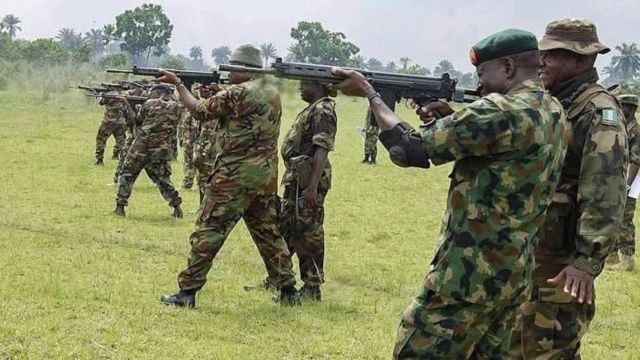
President Bola Ahmed Tinubu‘s approval for the expansion of the Nigerian Army from eight to twelve divisions marks one of the most ambitious military restructuring exercises in recent years. Coupled with the recruitment of 28,000 additional personnel and sustained investment in equipment, operational readiness and troop welfare, the decision reflects an acknowledgement that Nigeria’s security challenges have grown in scale, complexity and geographical spread.
The approval comes at a time when the country continues to grapple with insurgency in the North East, banditry across the North West and North Central, violent communal conflicts, kidnapping, attacks on critical infrastructure, oil theft in the Niger Delta, and other forms of organised criminality that demand a more responsive and better coordinated security architecture. Expanding the Army’s operational footprint therefore represents a significant policy decision that deserves careful consideration beyond the announcement itself.
Under the approved structure, the Nigerian Army will operate twelve divisions strategically distributed across the federation. The existing formations include the 1 Division Headquarters in Kaduna, covering Kaduna, Kano, Katsina and Jigawa States; the 2 Division Headquarters in Ibadan, responsible for Oyo, Osun, Ekiti and Ondo States; the 3 Division Headquarters in Jos, covering Plateau, Bauchi and Gombe States; the 6 Division Headquarters in Port Harcourt, overseeing Rivers, Akwa Ibom and Cross River States; the 7 Division Headquarters in Maiduguri, responsible for Borno and Yobe States; the 8 Division Headquarters in Sokoto, covering Sokoto, Kebbi and Zamfara States; the 81 Division Headquarters in Lagos, responsible for Lagos and Ogun States; and the 82 Division Headquarters in Enugu, covering Enugu, Anambra, Abia, Ebonyi and Imo States.
The newly approved formations include the 5 Division Headquarters in Makurdi to oversee Benue, Nasarawa and Kogi States; the 9 Division Headquarters in Ilorin, covering Kwara and Niger States; the 10 Division Headquarters in Jalingo, responsible for Taraba and Adamawa States; and the 83 Division Headquarters in Benin City, which will oversee Edo, Delta and Bayelsa States.
Government believes these additional formations will strengthen command and control, decentralise operational decision making, reinforce border security, improve the protection of critical national infrastructure, enhance counter-insurgency and internal security operations, and enable faster military responses to emerging threats across the country. Those objectives are both necessary and desirable, particularly because many security threats have become increasingly localised and often require rapid deployment backed by effective intelligence and coordinated command structures.
The planned implementation schedule also deserves attention. The first phase, covering the establishment of the 5, 9 and 10 Divisions together with the reorganisation of existing formations, is expected to be completed by September 2026. The second phase, involving the creation of the 83 Division and further restructuring, is scheduled for completion by December 2026. Such a timeline demonstrates a structured approach rather than an abrupt expansion, although meeting these deadlines will require disciplined planning, adequate funding and sustained political commitment.
Beyond establishing new headquarters, however, the true measure of success will lie in operational effectiveness. New divisions alone cannot resolve Nigeria’s security crisis unless they are backed by sufficient manpower, modern equipment, quality intelligence, efficient logistics and strong inter-agency cooperation. Military formations require more than official designations. They need barracks, communications infrastructure, mobility assets, surveillance capabilities, air support where necessary, medical facilities and dependable supply chains capable of sustaining operations over extended periods.
The approval for recruiting 28,000 additional personnel is therefore an important component of the broader strategy. Nigeria’s security environment demands a force that is sufficiently large, professionally trained and adequately equipped to respond simultaneously to multiple threats across different theatres of operation. Recruitment, however, must maintain rigorous professional standards. Expanding numbers should never come at the expense of competence, discipline or operational readiness.
Equally important is the administration’s continuing investment in troop welfare. Soldiers operating in difficult environments deserve decent accommodation, prompt payment of allowances, quality healthcare, reliable insurance arrangements and support for their families. Morale remains one of the strongest determinants of military effectiveness. Personnel who feel valued are better positioned to perform demanding assignments with commitment and professionalism.
The proposed restructuring also offers an opportunity to improve coordination between military commands and other security agencies. Many contemporary security threats require joint operations involving the Army, Air Force, Navy, Police, intelligence agencies, civil defence and local authorities. A decentralised command structure should facilitate quicker decision making and better operational synergy, provided communication channels remain efficient and institutional rivalries are kept under control.
Communities expected to host the new divisional headquarters may also experience wider economic benefits. Military installations often stimulate infrastructure development, generate employment opportunities, increase commercial activity and improve access to public services. These secondary gains, while welcome, should remain complementary to the primary objective of strengthening national security.
President Tinubu’s commendation of the Chief of Army Staff, Lieutenant General Waidi Ibrahim Shuaibu, alongside officers and soldiers of the Nigerian Army, recognises the sacrifices made daily by personnel confronting dangerous security situations across the country. Their dedication deserves public appreciation, but recognition must continue to be matched with the resources required to accomplish increasingly complex missions.
Nigeria has witnessed numerous security initiatives over the years, each introduced with considerable optimism. The expansion to twelve divisions should therefore be assessed by measurable outcomes rather than policy announcements alone. Citizens will judge the initiative by whether communities become safer, highways become less dangerous, kidnappings decline, terrorist activities are contained more effectively, critical national infrastructure receives stronger protection, and businesses can operate with greater confidence.
The administration has taken a significant step by approving a broader force structure and reinforcing the Army through additional recruitment and continued investment. The responsibility now shifts to implementation. Success will depend on sustained funding, disciplined execution, transparent oversight and continuous evaluation to ensure that every new formation contributes meaningfully to national security. Nigerians deserve a military structure that is capable of responding swiftly to evolving threats and restoring confidence that the state’s security institutions can protect lives, property and the country’s territorial integrity.