
Poetry Column-NND’s Ilemobayo Victoria Ojo caught up with Adamu Yahuza Abdullahi, author of The Rainbow Is Not As Beautiful As My Ruins, to discuss his motivations, craft, and recent HCAF Excellence Award.
I am Adamu Yahuza Abdullahi, a poet and visual artist from Borgu, Nigeria. I am a member of The Poetic Collective ( TPC), HCAF, and Borgu Book Club. It’s cold here in Kemanji, my ancestral home, where I am answering these questions from, and my lover is not home.
What inspired the themes and ideas explored in your latest book, “The Rainbow Is Not As Beautiful As My Ruins,” and how do you see your work contributing to the literary landscape?
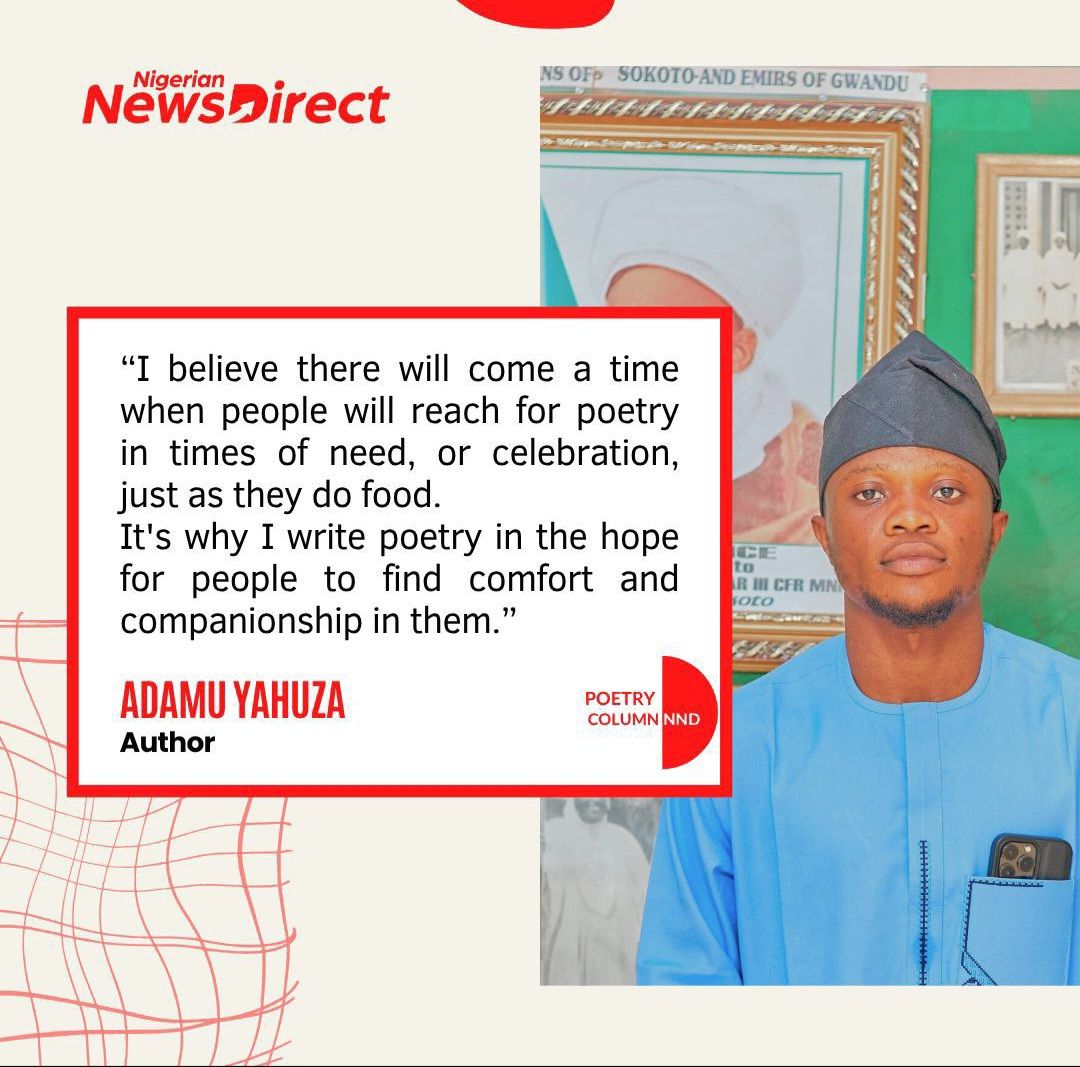
The themes in “The Rainbow is Not as Beautiful as my Ruins” were inspired by loss; personal and communal. the personal being the loss of my brother Mubaraq, whom i’ve grown so much loving. Mubaraq inspired me to write, and it was him who edited my first poem, hence the special bond. When he died, poetry became the only means by which I could touch him. The communal loss has to do with the socio-political happenings in our immediate environment – Nigeria. Every day, the country breaks us. Isn’t it miraculous, how we made it this far?I have begun to believe in, and even to preach, that grief is a universal feeling. By navigating mine, I navigate the sorrows of a million other people. my poetry desire to explore the experience of death, to re-experience it through language—to provoke and not just describe, the pain of passing. Hence, they focus less on the often formal process of mourning and instead on the personal and often bewildering process of grief.Because my poems, beckoned by need, evince their origin from the urge to break silence, to interrogate, to annihilate, or to simply understand; they will contribute to the literary landscape in the sense that, while other poets approach death to judge or blame, i approach it to understand; to hold a conversation with it. possibly because i believed in impermanence, i knew i could not last forever. However, I could make sense of every monumental moment. I believe there will come a time when people will reach for poetry in times of need, or celebration, just as they do food. It’s why I write poetry in the hope for people to find comfort and companionship in them.
What is your creative process and are there any notable challenges or breakthroughs you experienced while writing this collection?
My writing process begins with imagination and hallucination. Before anything else, I imagine, I hallucinate. I court ecstasy and longing, I journey into the dark, the mysterious, external spheres of my mind, body and soul, wherein the poems are formed. The last stage of my creative process is the very act of putting the poems on the page. The process is also reflective of my mood at the moment. In rare instances, I skip the imagination and hallucination stage. The challenges that I encountered while writing my collection were emotional ones. I think every poet feels that. Because most of the poems center around the loss of my brother, I’m constantly reminded about his presence and absence, and therefore, the urge to touch him more. The memory keeps haunting. I begin to remember the littlest moments I’ve had with him, and how much I tend to appreciate them now. It’s what I meant when I said (in two-year old a metaphor), that: “there is something about obsession, how it always happens before purpose”. they offered sympathy, which can sometimes cause more anxiety than comfort. While collating the poems, I’m reminded of how much I’ve survived on death alone.
Can you tell us your favorite poem in “The Rainbow Is Not As Beautiful As My Ruins,” and what it means to you?
I have a very good relationship with ‘Everyday I Decide To Die’ and i can easily say it’s my favorite in the collection. The poem served its purpose, which was to keep me alive. A writer’s primary duty is to please themselves. When I wrote the poem, I was at my minimum, almost losing it. The title is a confession, a cry. I wrote the poem from a place of necessity, and I have learned that necessity is what drives the poetry that matters. No one wants to write a sad poem – say an elegy– I presume we simply must. When Mubaraq died, I was depressed. I begin to think about the temporariness of things, life inclusive. But thinking alone does not help when it comes to grief. to lose is to enter a canoe of experience no quantity of forethought or hindsight can rescue you from. The thing with grief is, you must accept it. You can not outwit it. you must survive the sorrow. so in Everyday I Decide To Die, I accepted Mubaraq’s death, and in that acceptance came healing.
Who are some poets or writers who have inspired your work?
There are many poets on this list. There is Samuel Ayokunle Betiku, whose poetry astounds me for its profundity and striking imagery. There is Chiwenite Onyekwelu for his unique language, Chinua Ezenwa-Ohaeto for his simplicity. and there’s Andrea Gibson, whose poetry reads like a visual description of my life. There’s Michael Wasson for his visceral soulfulness. There is Warsan Shire, whose poetry I love for its honesty. There is Michael Imossan, whose metaphors haunt me. There’s Samuel Adeyemi, whose poetry is raw and full of revelation. and there’s Pamilerin Jacob, whose poetry I read to catch up with my metaphor classes.
Yahuza, how do you unwind?
I begin with food. I eat, because Joy Harjo said, “the world begins at a kitchen table. no matter what, we must eat to live.” I take a walk. I listen to music. I watch movies. I gaze at the moon, the stars, and on lucky nights, the rainbow. I read my favorite poetry collections. i sleep. I daydream. I dream. I visit my uncle, who jokes beautifully and tells me wise words. I spend time with my mother. My father loves to talk about politics, and I don’t fancy it, but I still talk about it with him. I scroll the internet; I read how many more inches of misery my country has grown. somewhere, i’ll stop to watch a few reels of Lamine Yamal. I unwind by spending time alone in my room, where I call my lover and tell her how she looks like something that could end me, and how gladly I’d be ruined by her. she’d confessed that she hasn’t been loved that holy before. I gist with my sweet, crazy friends– Razaq and Tesleem, whose bad advice I always long for.
What’s next for you in terms of writing projects or publications?
I am currently rounding up with edits on my sophomore. I hope it finds a beautiful home like my debut. I also have forthcoming publications that I’m anxious about. I have not written in a while, I hope to resume writing soon.
It is no longer news that you are one of four considered for the HCAF Excellence Award, How do you feel about it?
I feel grateful. that it came from HCAF makes me overly excited. It’s one award I will cherish for a lifetime.
BIO:
Adamu Yahuza Abdullahi, THE PLOB, TPC V, whose works have appeared in Lolwe, Strange Horizons, CHESTNUT REVIEW, Deadlands, Banshee Press, Reckoning, and other places, is a poet and visual artist from Borgu, Nigeria. He is a pioneer Fellow of Muktar Aliyu Art Residency, Minna, Niger state, Nigeria. He is a finalist of the 2024 Garden Party Collective chapbook contest, and second place winner of both the first edition of Hassan Sulaiman Gimba Esq Poetry Prize and the Bill Ward Poetry Prize for Emerging Writers 2023. He is the author of the chapbook The Rainbow is Not As Beautiful as my Ruins ( Felis Catus, 2025).
Victoria Ilemobayo Ojo is a high-achieving individual, consistently pushing the boundaries of what’s possible. Victoria has built a diverse portfolio, featuring published works, stunning smartphone photography, engaging storytelling, and creative workshops. Driven by an insatiable desire for self-growth. She continues to strive for excellence, inspiring creatives with her energy, creativity, and determination.


