
Daniel Okezue shines in The Coffee Shop: A theatrical mirror to Africa’s soul

by Flourish Joshua
Bradford’s cultural heartbeat pulsed with emotion and pride as the Nigerian Community Association Bradford (NCAB) marked Nigeria’s 65th Independence anniversary with colour, laughter, and sober reflection.
The evening’s centrepiece, The Coffee Shop, a theatre production written and directed by Chris Iheuwa, became more than entertainment; it was a mirror held up to Africa’s conscience.
Staged in collaboration with the British African Arts and Theatre Ensemble and Staple Stage Productions, the play explored the contradictions, humour, and hope of Africans at home and in the diaspora.
At the heart of the performance stood Daniel Okezue, the award-winning performer who embodied Obi, a passionate Pan-Africanist advocating unity, self-determination, and collective empowerment. Alongside co-actors Tope Dada, Victor Moses, and Queen Esther, Okezue brought an intensity that felt both intellectual and deeply human.
“Obi as a character was designed to speak for those who haven’t yet found the courage to speak,” Okezue told Nigerian News Direct after the show.
“He’s that fiery spirit who believes Africa’s redemption starts in the mirror with us, the people.”
Okezue described The Coffee Shop as a reflection of the African condition, the restless debates, the deferred dreams, and the stubborn hope that refuses to die.
“When Chris first shared the script,” he said, “I knew it was more than a story, it was a statement. Obi’s passion and faith are every African I know. They’re me too.”
Laughter rippled through the hall as satire met truth; silence followed where words struck deeper chords. Dr Olusola Kolawole, NCAB President, called the production “a celebration of our shared consciousness, of what it means to be Nigerian, African, and human.”
“I could see faces change during the performance,” Okezue reflected.
“Some people laughed, some frowned, and others just nodded quietly. That’s the magic of theatre, it’s not about agreement, it’s about awakening.”
Asked what drives his creative choices, Okezue paused before replying with conviction:
“Purpose. I don’t do art just to entertain, I do it to start conversations. Art is activism wearing the robe of creativity. Every time I step on stage, I’m asking: what truth are we afraid to tell?”
That philosophy shapes his career across theatre, poetry, and comedy, mediums through which he balances intensity with levity, compelling audiences to think even as they smile.
“Laughter opens the door,” he added. “Once people laugh, they listen. And once they listen, you can plant a seed, maybe one that grows into something powerful.”
By curtain call, The Coffee Shop had become a conversation rather than a conclusion.
Through Okezue’s performance, the audience rediscovered the enduring truth that art is not luxury but necessity, a means of remembering who we are and imagining who we might become.
“Art,” Okezue concluded softly, “is how we remember and how we rebuild.”
In The Coffee Shop, Daniel Okezue didn’t just play Obi.
He became Africa’s mirror, reflecting her struggles, her laughter, and her unbroken song of hope.
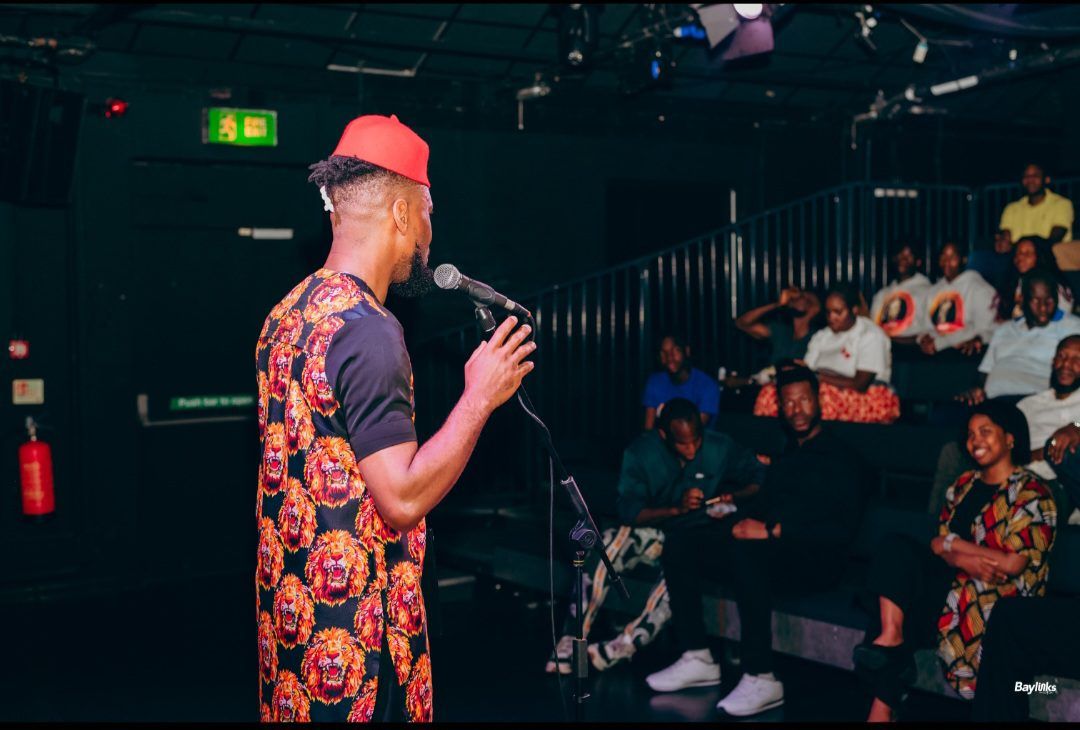
Photo Credit: Baylinks Media